
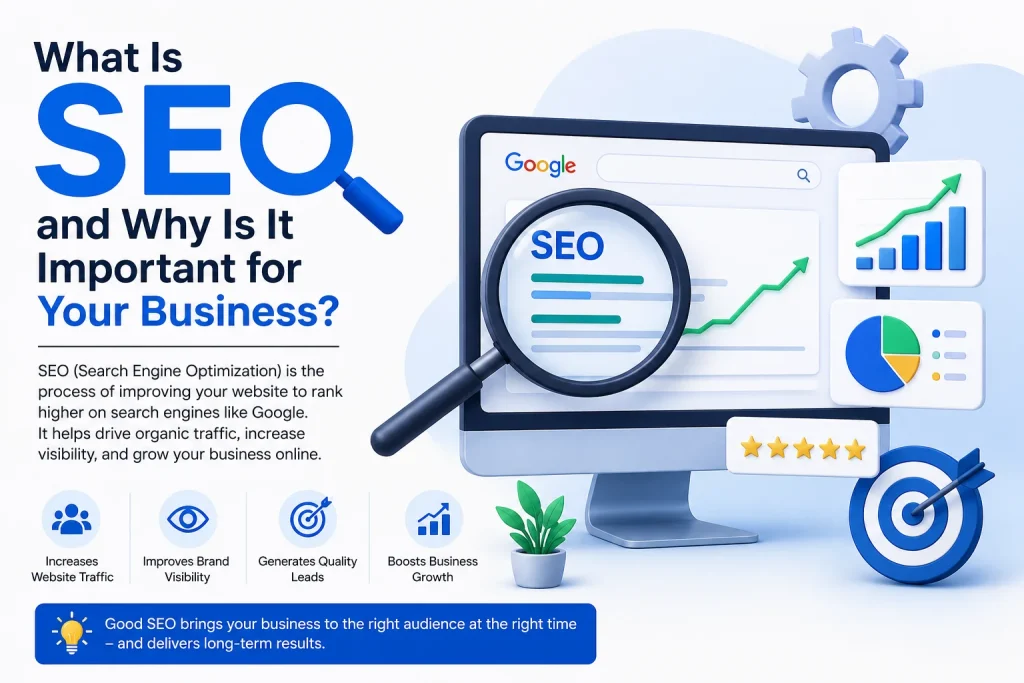
What Is SEO and Why Does Your Business Need It?

Introduction
In the digital age, having a website is insufficient. If your customers do not see your business online, then you are losing out on very well–deserved chances to scale. SEO stands for Search Engine Optimization, here is where SEO comes in.
This makes SEO one of the least expensive digital marketing techniques, since it aids your website in ranking higher in search engine results pages, thus making it simpler for prospective customers to find your products or services.
SEO can help you to increase your online visibility, get targeted online visitors without depending on paid ads, you are a small business or startup or an established one.
What Is SEO?
Search Engine Optimization (SEO), refers to the process of optimizing your website so that it appears more often in search engines, such as Google, Bing and Yahoo when a user searches for products or service associated with your business.
SEO (search engine optimization) aims to get organic traffic — meaning people who discover your site organically via search engine results rather than paid ads.
Let for the sake of this example say, you have bakery in Delhi and searching by any user looked up on Google as “best bakery near me” then with SEO your website has more possibilities to represent upto number one.
How Does SEO Work?
This discovery and indexing process is performed by automated programs known as crawlers (also called spiders or bots) used by search engines across the world wide web.
Once someone does a search, the search engine analyzes thousands or maybe millions of pages on:
- Content quality
- Keyword relevance
- Website speed
- Mobile friendliness
- User experience
- Website security (HTTPS)
- Backlinks from trusted websites
- Page authority
- Freshness of content
It ranks the pages that best fit the user intent that you are looking for.
Importance of SEO in Your Business?
1.Increases Website Visibility
The vast majority of the time, users click on one of the top few search results. Higher the ranking, more you get seen by potential buyers【9†source】【10†source】.
- Higher visibility leads to:
- More website visitors
- Greater brand awareness
- Increased customer trust
2.Drives High-Quality Traffic
Unlike a traditional advertising model, which pushes ads out to people regardless of whether they are actually looking for what is being sold, SEO seeks to attract visitors with search intent.
For example:
- A visitor who is searching for “cheap digital marketing company” as compared to seeing some random ad, is more likely to convert.
- This is what makes SEO one of the highest converting marketing channels.
3.Builds Trust and Credibility
The higher your site appears on Google data (all readers trust it).
- Strong SEO includes:
- Helpful content
- Secure websites (HTTPS)
- Fast loading speeds
- Positive user experience
- Authoritative backlinks
These factors allow your business to become a trusted source of information.
4.Generates Long-Term Results
Paid ads only create outbound traffic while your budget lasts.
SEO is different.
While it takes time to build traction, a properly optimized site with great content will continue to bring in visitors for months or even years with regular maintenance and quality content.
5.Improves User Experience
SEO is more than just your search engines; it also allows people to use your website better.
Good SEO practices include:
- Faster loading pages
- Mobile-friendly design
- Clear navigation
- Easy-to-read content
- Well-structured pages
Providing a good user experience makes visitors stay longer and increases the chances of conversions.
6.Provides Higher ROI
SEO usually gives one of the finest long-term returns on investment available to digital marketers.
Rather than investing in something that holds no future value, you have a form of permanent visibility — one piece of content leads to another and gets you consistent traffic over time.
Types of SEO
1. On-Page SEO
On-page SEO involves optimizing elements within your website.
Examples include:
- Keyword optimization
- Title tags
- Meta descriptions
- Heading structure
- Internal linking
- Image optimization
- High-quality content
2. Off-Page SEO
The off-page SEO is basically techniques which takes place outside of the website in order to increase authority.
Examples include:
- Building quality backlinks
- Brand mentions
- Social media promotion
- Guest blogging
- Online reviews
3. Technical SEO
ISEO helping search engines to crawl and index your website efficiently.
It includes:
- Website speed optimization
- Mobile responsiveness
- XML sitemaps
- Robots.txt configuration
- Structured data (Schema Markup)
- Fixing crawl errors
- Secure HTTPS connections
4. Local SEO
For Example, Local SEO is for businesses that show up in local searches like ‘coffee shop near me’ or ‘electrician in Mumbai’.
It includes:
- Optimizing your Google Business Profile
- Managing customer reviews
- Using local keywords
- Building local citations
- Keeping Business Information Consistent Across Directories
Local SEO is particularly beneficial to businesses that serve a certain region.
Aspects of SEO that can Benefit Businesses
Increased Organic Traffic
SEO brings visitors who are already searching for what you provide and drives more relevant traffic without paying each time someone clicks.
Better Brand Visibility
Getting listed more on search results gets you in front of more eyes so people become familiar with your business, products and services.
Higher Credibility and Trust
Users see the websites that are ranked higher on Google to be more trustworthy and authoritative.
Improved User Experience
SEO actually promotes very fast loading pages, responsive web design, simple intuitive navigation, and of course content that is useful to the website visitor.
More Qualified Leads
Users discovering your website from search have intent, so they are much more likely to become customers.
Cost-Effective Marketing
Join the conversation: As much as SEO takes time, skill and dedication to understand fully it returns you long-term results by driving ongoing traffic that you do not have to pay for each visit.
Competitive Advantage
Competitors who do invest in SEO will have the best chance of getting customers that would be searching online for your services or products more likely than you. That ensures that your business remains competitive, right?
Essential SEO Ranking Factors
Search engines rely on many signals, and among the most basic are:
- High-quality, helpful content
- Search intent alignment
- Relevant keywords
- Mobile-friendly design
- Fast page loading speed
- Secure HTTPS connection
- High-quality backlinks
- Strong internal linking
- Positive user experience
- Fresh, regularly updated content
Common SEO Mistakes to Avoid
Too many businesses inadvertently diminish their search performance by making avoidable errors like:
- Keyword stuffing
- Publishing duplicate or thin content
- Ignoring mobile optimization
- Slow website speed
- Absence of title tags and meta descriptions
- Broken internal links
- Poor site structure
- Neglecting local SEO
- Buying low-quality backlinks
How Long Does SEO Take?
SEO is not something you can fix over night, it’s a long-term strategy. With real competition, website history and good optimizations the visible results can generally start to occur within a 3 — 6 months window depending on your market. In highly competitive markets things may take longer.
The key to permanently lasting results is consistent working on useful content, technical improvements and building authority.
Best Practices for SEO Success
In order to maximize your possibilities of achieving a high ranking in search results:
- Write high-quality, unique content that solves the client need.
- Find related keywords and add them to your post naturally.
- Edit the page title and meta description.
- Website speed and mobile usability
- Ethically Create High–Quality Backlinks
- Use descriptive internal links.
- Keep content updated and accurate.
- Step 3: Using Analytic and Search Console Tools to Monitor Performance
SEO is more effective as an ongoing service than as a project.
Conclusion
Search Engine Optimization is one of the best way to gain omnipresence. SEO, or search engine optimization, is the process of optimizing your website to rank higher in search results to attract more traffic over time and generate qualified leads for your business while building trust through your brand.
From a brick-and-mortar business to an eCommerce store or service provider of any kind, SEO generates long-lasting value for your investment. Putting energy into making valuable content, good technical practices and a good user experience sets up your site to be successful in search engines and better serve its customers.